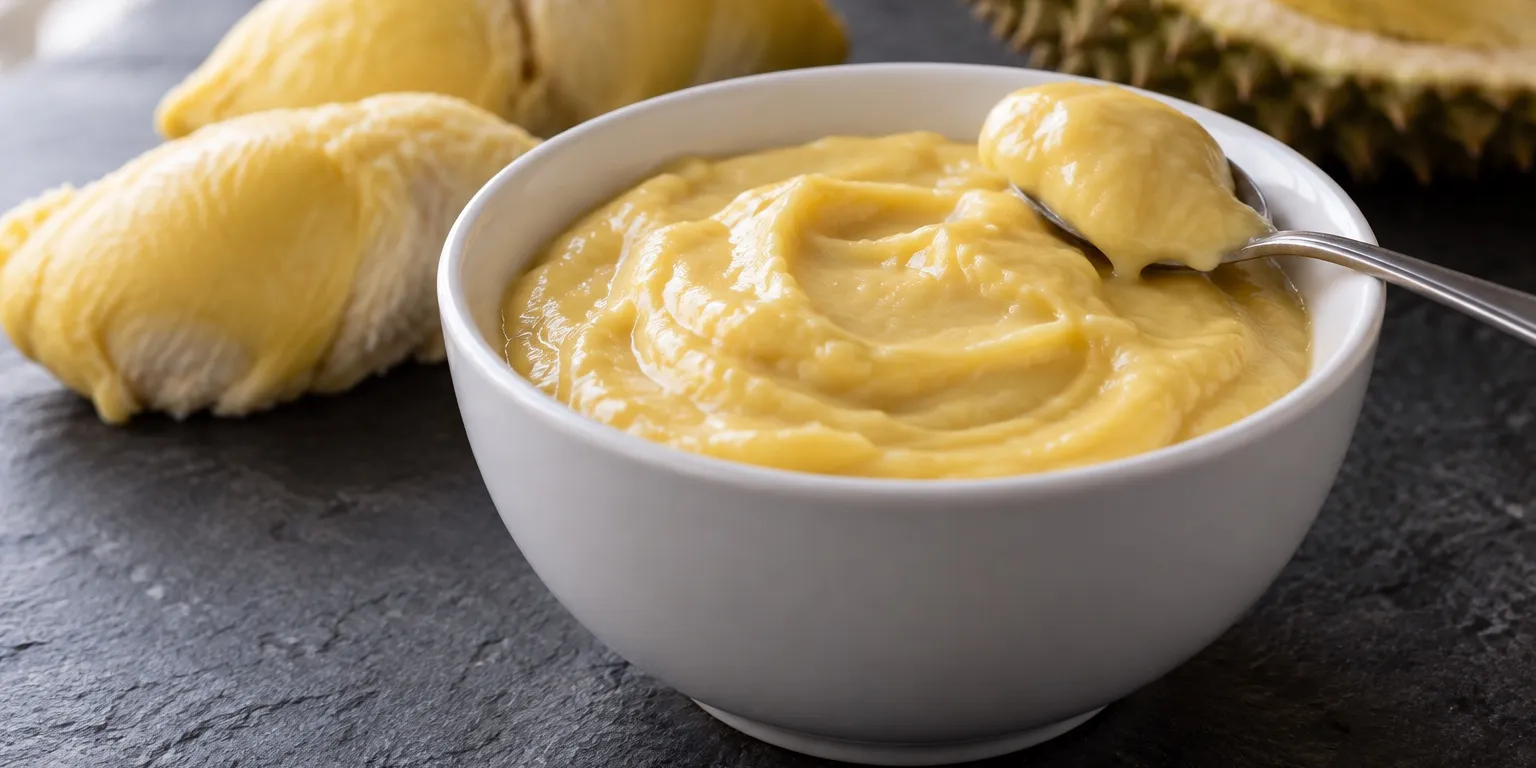
Royal Durian, a Singapore durian seller, makes its own Musang King purée in small batches each season. By the seller’s own account, the quality comes from decisions made before anything is blended: one variety only, poor fruit thrown out rather than mixed in, frozen storage, and batches no bigger than the season’s good fruit allows.
It is Musang King and nothing else
As our guide to durian purée for kitchens explains, the word purée has no fixed composition. It can be a blend of varieties, and it can carry water or sugar, at ratios that differ from one supplier to the next. Some sellers in Singapore name the variety on the pack and some do not, so the label is the first thing to read.
Royal Durian sells its product by name as Musang King purée, and says so consistently, in its pre-orders, its costings and its own desserts. MSW, the shorthand the trade uses for it, stands for Musang King, the D197 clone.
That matters for a dessert. Musang King’s thick, creamy flesh, with its pronounced bitter undertone, behaves differently from D24 or a kampung durian once it is folded into cream or baked into a pastry. A single-variety purée removes one source of difference between batches. It does not remove the rest: fruit from different trees and different weeks still varies.
The seller has also shared a photograph of what it calls the real colour of its Musang King purée, and told buyers they could use it as a reference.
Poor fruit is thrown out, not blended in
The easiest way to make cheap purée is to put everything in: the fruit that did not ripen properly, the chambers that went watery, the pieces that would never sell whole. Blending hides how fruit looks. It does not hide how it tastes.
Royal Durian’s stated position is that some fruit is not good enough even for purée. Of one batch of poor fruit, the seller said those durians could not even be made into purée.
That discipline has a cost, and the seller has put a number on it. If rejected flesh adds up to 2kg in every 10kg bought, fruit at an average of $40 per kg becomes purée costing about $50 per kg. That is the seller’s own illustration of why its price sits above cheaper purée, not a price list, and it is worth reading as such. It is also the honest shape of the trade: a purée made only from good fruit has to carry the cost of the fruit that did not make it.
Kept frozen
A 2020 study held Musang King and D24 pulp frozen for a year and found freezing held microbial contamination down, at the cost of gradual softening and some loss of beta carotene. Our purée guide sets out that study and the one published shelf-life code for frozen fruit purée.
Royal Durian treats purée as a frozen product. The seller has described meeting another exhibitor at a trade fair who claimed their purée could be kept at room temperature, and disagreeing, on the grounds that purée starts from frozen. That is the only thing we found the seller saying about how purée is stored, and it gives no shelf life or storage temperature, so ask for both. Its frozen menu has also included Musang King gelato and choux puffs.
Small batches, because the season decides
Royal Durian’s purée follows the season. The seller takes orders ahead and asks buyers to pre-order early. How much purée there is to sell depends on how much good fruit the season delivers, and 2026 showed what that means in practice.
When orders opened in July, the seller called the purée a limited edition and said there was very little of it because the season was short. Two weeks later it said only 200 boxes of its Musang King mooncakes were left, because there was not enough purée.
Running short is what you would expect from a seller who does not stretch the product, though on its own it does not prove that. If you want this purée, the lesson from 2026 is to ask early in the season, not at the end of it.
Seven questions to ask before you order
These are the questions our purée guide recommends asking any supplier. Royal Durian has not published answers to them, so put them to the seller directly:
- Composition. Whether it is pure Musang King pulp, or has water or sugar added, and in what proportion.
- Price per kilogram of purée. The $50 figure above is a worked example, not a quoted price.
- Pack format and size, and whether a pack can be portioned without thawing all of it.
- Stated shelf life, at what temperature, and counted from what date.
- Food safety certification, such as halal or HACCP, if your kitchen needs it.
- Minimum order and lead time, given that supply is set by the season.
- Delivery, and how the purée stays frozen until it reaches your freezer. Our guide to taking delivery of a durian order covers what to check at the door.
A good supplier will answer all seven without hesitation. Asking is not a sign of distrust. It is how you compare one kilogram of purée with another.
About Royal Durian
Royal Durian sells fresh Musang King and its own frozen desserts, including through TikTok. CNA has quoted it in three durian seasons: 2021, 2025 and 2026. The seller says its purée goes into its own ice cream and mooncakes as well as being sold on its own.
Royal Durian takes purée enquiries on WhatsApp. Supply depends on the season, so ask whether any is available and when the next batch is expected: send a purée enquiry on WhatsApp.