What it actually is
Musang King is D197, registered with Malaysia’s Department of Agriculture on 9 December 1993. In Malay it is Raja Kunyit, the turmeric king. In Mandarin it is Mao Shan Wang. All three names are the same clone.
Here is the part almost every listing gets wrong. Musang King is sold everywhere as a Pahang durian, and FAMA’s standard names Pahang, with Johor, as its main production areas. But it is a Kelantan durian by origin. The Department of Agriculture’s published entry for D197 records the variety as coming from Tanah Merah, Kelantan (Department of Agriculture). Pahang is where most of it is grown now, not where it came from.
You will very often read that the original tree was found in Gua Musang instead, and that the district is where the name comes from. It is repeated almost everywhere, but it is not what the register says, so we have followed the register and left the etymology alone.
So “Pahang Musang King” is a claim about where the fruit was grown. Growers and sellers say old-tree fruit from Pahang eats differently, though no grading standard measures it. It is not a claim about authenticity or lineage. “Original Kelantan stock”, by contrast, means considerably less than it sounds.
How to spot it
The fruit is round to oval. Malaysia’s own FAMA standard for Musang King sizes it small at 0.8 to 1.2kg, medium at 1.3 to 1.7kg, large at 1.8 to 2.2kg, and classes anything above 2.3kg as extra large. The ASEAN standard gives the variety a range of 1.0 to 3.0kg, and the Department of Agriculture gives 1.0 to 1.8kg. So a typical fruit is nearer 1.5kg than 3kg, and a genuinely heavy one is uncommon rather than standard.
FAMA describes the husk as light green, sometimes a brownish grey-green, and the stalk as brown and of medium length.
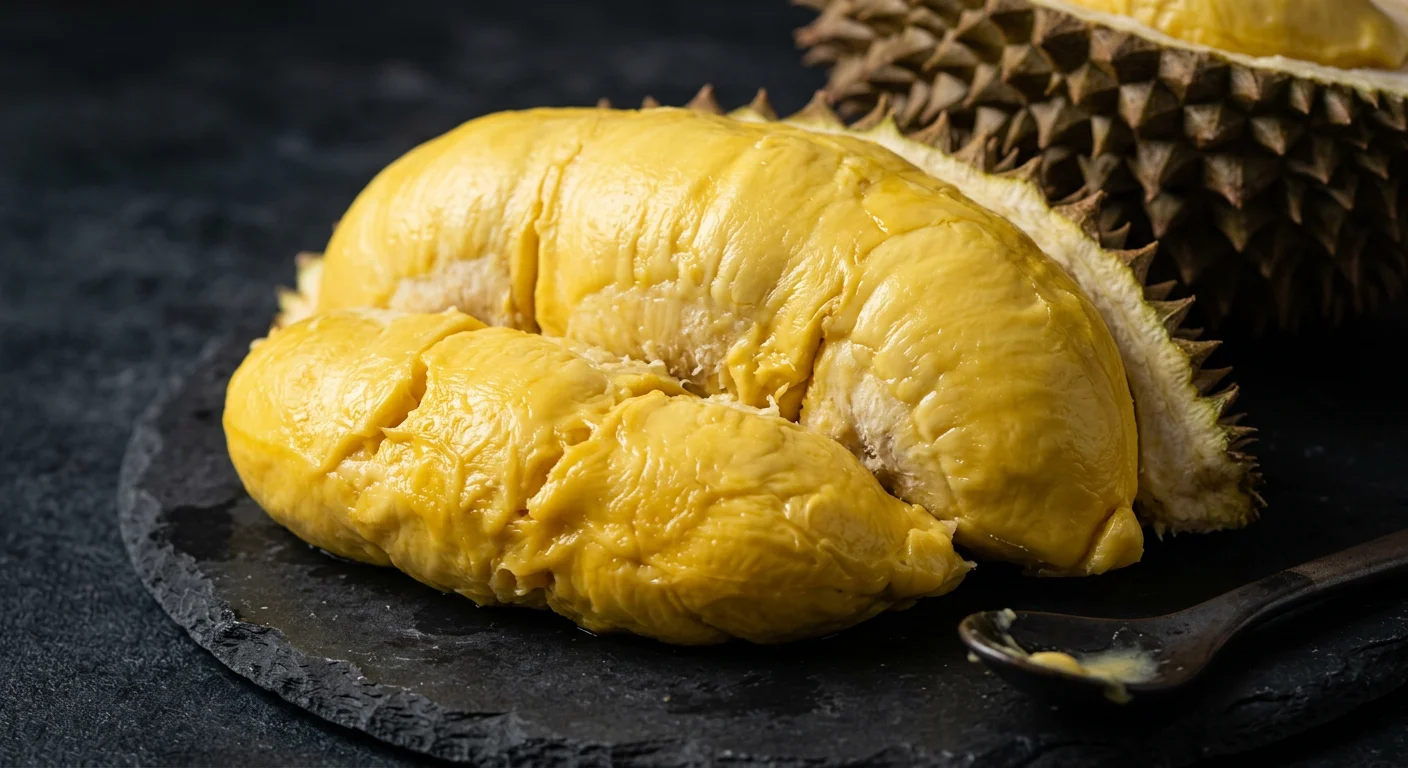
The thorns are the first tell: fairly large, medium-short and pyramid-shaped, in FAMA’s words. FAMA also notes a clear thornless ring around the base of the stalk.
The base is the real signature. Musang King carries a star-like pattern of brownish lines where the segments meet at the bottom, which FAMA’s Musang King standard lists as the variety’s distinctive feature. Treat it as a check on the variety, not a measure of the flesh inside.
Opened, the flesh is a strong yellow: the Department of Agriculture calls it very yellow, and FAMA lists yellow, turmeric yellow and golden yellow. FAMA describes the seeds as flat, with some medium-large, and the flesh as coming away easily from the seed.
What it tastes like
Thick, smooth and firm, in FAMA’s words.
The flavour is the reason for the price: rich sweetness with a bitter edge; FAMA’s standard describes the taste as rich, sweet and slightly bitter. The bitterness is not a flaw or a sign of over-ripeness. It is the point, and it is what separates Musang King from the sweeter clones.
The aroma is strong, as FAMA’s standard also notes.
Against Black Thorn (D200), SAYS describes Black Thorn as creamy, lighter and less overpowering than Musang King. Against D24, the official descriptions are close: the Department of Agriculture also gives D24 a slight bitterness, so taste the two side by side rather than relying on the label.
What to watch for
Bitterness is not a defect. The most common mistake among newer buyers is sending back or avoiding fruit that tastes bitter, when that bitterness is exactly what they paid for. If you want something milder, D13 is described as mild and sweet, and Red Prawn as sweet with a tinge of bitterness. You should not be paying Musang King prices for either.
Watch the grade and the state, not the name. Musang King is graded, and the gap between grades is wide. In 2026, a glut year, Grade A Musang King from one Karak orchard sold in early July for about half what it fetched in the same period of 2025 (AP via The Star), so “Musang King” alone tells you very little about what you are getting. The current season picture has the numbers.
“Old tree” is a selling line, not a grade. As above, growers say mature Raub fruit eats differently, so the idea behind the claim is not empty. The problem is that nothing upstream prices it. Malaysian farm-gate and collection-station pricing is built on shape, size and how many chambers filled out, and buyers who work those markets report no line on any price list for old tree, black gold or any other special name. The premium therefore appears somewhere between the orchard and the counter, attached to a claim the person quoting it usually cannot evidence and you certainly cannot check.
Treat the supporting tells with the same caution. Age does not reliably predict small seeds: buyers with long experience of these orchards report plenty of genuinely old trees dropping large-seeded fruit. Husk colour is not proof of a highland or an old tree either, and the explanation given by people who handle the fruit daily is simple, that a grey husk is a sun-exposed one and washing it returns it to green, with lowland trees giving grey husks and tall old trees giving green ones. None of this makes old-tree fruit bad. It means the claim is not something you can verify at a stall, so buy on the fruit in front of you, which you can inspect.
Finally, check whether the price quoted is whole fruit or packed flesh. One recent review puts edible flesh at 15 to 30 per cent of whole-fruit weight, so the two numbers differ by several times and neither is dishonest.
Is King of King the same as Musang King?
You will see Musang King sold as King of King, written 王中王 and romanised wang zhong wang. It is worth knowing what that name is and what it is not.
It is not a variety. Musang King is one registered clone, D197. There is no separate clone called King of King.
It is not an official grade either. Malaysia publishes a standard written for this variety alone, FAMA Standard FS 092:2018. Section 7 classifies the fruit into three grades and names them: Premium, Gred 1 and Gred 2. Section 8 classes size by weight. The document does not contain King of King, or 王中王, or AAA, or Premium Plus. So the term belongs in the same box as those last two, a label the seller defines and nobody else.
That does not make it a lie. A stall genuinely selling Musang King and calling it King of King may be pointing at fruit it has selected, and the fruit may be excellent. The point is narrower: there is no written specification behind the name, so it is not a claim you can hold anyone to, and two stalls using it need not mean the same thing.
The same label also gets used for a different, cheaper fruit entirely. Durianed’s guide to fake Musang King names D168, which the Department of Agriculture lists as Mas Muar and which is also sold as IOI, among the durians marketed under this exact name, and the trade site DurianPro lists Wang Zhong Wang among D168’s own alternate names. D168 has usually sold for noticeably less than Musang King. If a King of King fruit tastes noticeably sweeter and milder than you expected, it may be D168 rather than Musang King at all.
Treat it exactly as you treat old tree, above. Buy on the opened fruit in front of you.
If you are buying for a kitchen rather than a table, the arithmetic is harsher. A King of King premium is paid for chamber count, size and appearance, and none of those survive the blender.
Who it suits
Not beginners, despite being the famous one. Its bitter finish divides people, so it is not the easiest place to start.
It suits anyone who already knows they like the bittersweet end, and anyone building a palate who wants the reference point everything else is measured against. If you are buying for a group, buy it alongside something gentler rather than on its own.