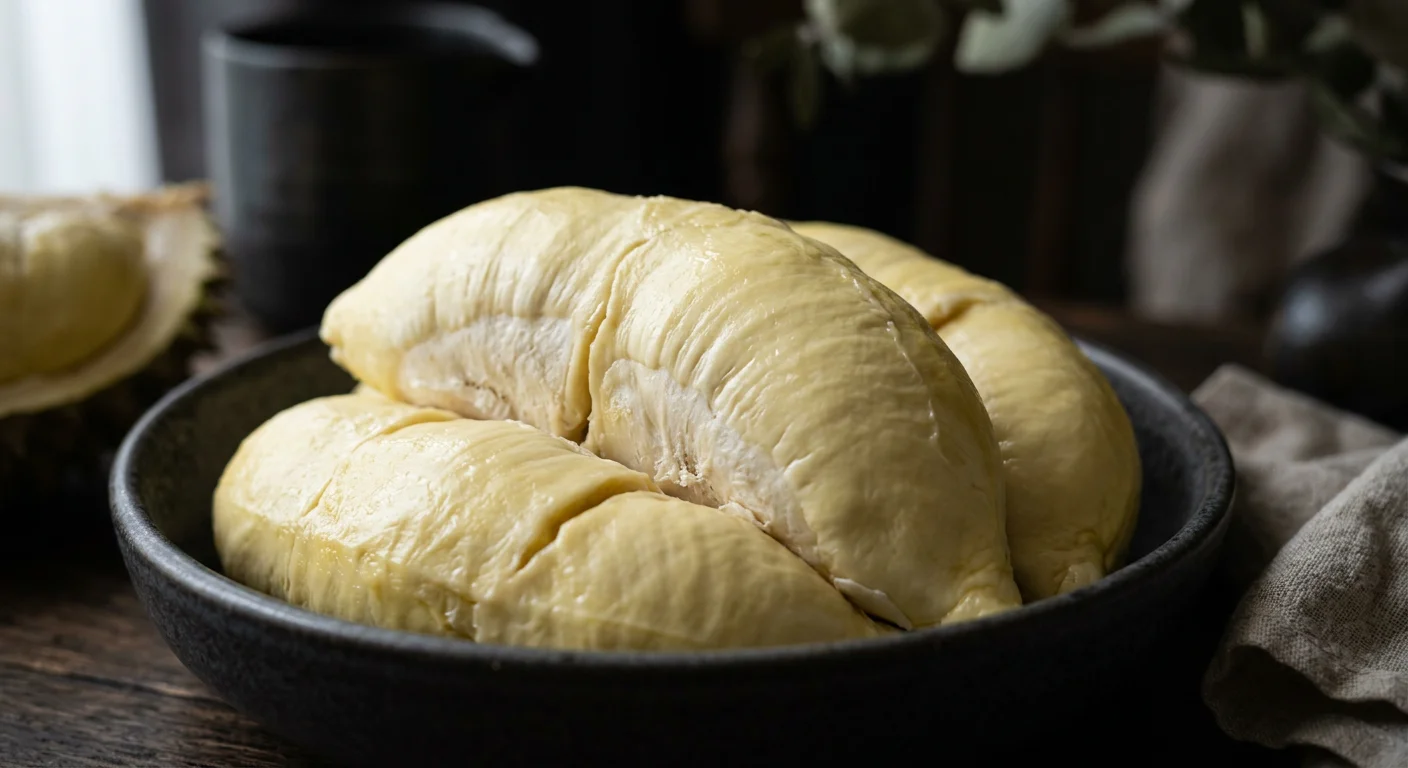
Short answer, as of 29 September 2026: for Malaysian fruit the 2026 main season is effectively over. The most recent harvest report we can find, from 25 July, had Johor and Negri Sembilan finished and Pahang down to its last 5 to 10 per cent. The glut was real, it ended in mid July, and prices have been back up since. Anything sold as Malaysian Musang King in mid September needs checking, because this is the time of year Thai fruit fills the gap. The newest report points the same way for the months ahead: on 27 September a Malaysian orchard owner said haze and dry weather had stalled flowering, and he now expects fruit due at the end of January to arrive at the end of February or early March.
Malaysia’s main season began in June and peaked through July. A bumper harvest across Pahang, Penang and Johor pushed prices to roughly half what they were in 2025, and the season was widely described in Malaysia as a durian tsunami. That part is not in doubt.
What has changed since is the part most pages have not caught up with. The Johor harvest wound down through the middle of July, supply tightened, and Singapore retail prices rose again well before August. By the last week of July, Klang Valley traders were telling the New Straits Times that Johor and Negri Sembilan had run out, Pahang had “about five to 10 per cent remaining”, and some of them were already sourcing from Thailand. If you were waiting for prices to fall further, that trade closed two months ago.
Is it durian season right now?
For premium Malaysian varieties, at the end of September, effectively no. Here is the state of play by region, with the date each reading comes from. The most recent report we found that describes the harvest region by region is dated 25 July. What we found dated August and September is set out under “When does the 2026 season end?” below, and none of it gives a regional reading, so the 25 July lines stand as the latest.
| Region | Status | As at |
|---|---|---|
| Johor | Finished. Klang Valley traders reported it had run out | 25 July 2026, NST |
| Negri Sembilan | Finished, per the same traders | 25 July 2026, NST |
| Raub, Bentong and Karak, Pahang | ”About five to 10 per cent remaining” per Klang Valley traders. An AP feature published 5 August describes night collection at a Karak orchard, but its only dated figure is an early-July price, so it does not update this | 25 July 2026, NST |
| Perak and Kelantan | Mostly kampung varieties, “almost finished” | 25 July 2026, NST |
| Balik Pulau, Penang | Trees fruited early this year and the state reported oversupply at the end of June. No dated harvest reading after that | March and June 2026, linked below |
| Selangor | No dated 2026 report. The general calendar has Selangor winding down through August | General calendar |
The same 25 July report carries the last dated Malaysian prices: Musang King and Black Thorn from RM25 per kg at Klang Valley stalls, hybrids RM18, kampung durian RM8, and one trader quoting Musang King at RM28 rising to RM42 per kg because “there is no stock”. A second trader said he would close his stall within days and reopen “when the next season begins”. That is what the end of a season looks like in the reporting, and it was already visible seven weeks ago.
Growers in Balik Pulau reported around 20% of their trees fruiting ahead of schedule back in March, after hot and dry weather triggered an early bloom.
Penang’s tonnage is worth setting out carefully, because the published figures do not agree with each other. Speaking at the end of June, with two months of the season still to run, the state’s FAMA director said production had risen “to more than 18,000 metric tonnes this year compared to about 17,000 metric tonnes last year”. In the same report, the Chief Minister gave Penang’s output as 17,910 tonnes in 2024 rising to 18,870 tonnes in 2025, which does not reconcile with a 2025 baseline of about 17,000. So treat 18,000 tonnes as a mid-season statement about a direction of travel, not as a final 2026 total, and note that the state’s own two figures for 2025 differ by nearly 2,000 tonnes.
Why 2026 got so cheap
Two things happened at once.
The first is acreage. A large number of durian trees planted between 2015 and 2020, during the Musang King export boom to China, reached full production this year. That is a step change in supply, not a normal fluctuation.
The second is weather. Conditions were favourable across the main growing states, so those trees produced well at the same time.
The result was described in Malaysia as a durian tsunami, a phrase the Federal Agricultural Marketing Authority’s own deputy director used on 24 June. Some numbers from the season, each with where it comes from:
- Grade A Musang King from one Karak orchard sold for about RM35.20 per kg in early July, about half the same period in 2025 and roughly a third of the 2024 peak (AP, 5 August, via The Star)
- On 24 June, reports had Musang King down from around RM90 per kg to as little as RM9, and at a Segambut roadside stall AFP saw premium Black Thorn and Musang King priced under RM25 per whole fruit (AFP via New Straits Times, 24 June)
- Singapore sellers on 24 June put Malaysian Musang King at about RM6 per kg across the border (AsiaOne, 24 June)
- In Penang on 30 June, one premium retailer listed Musang King at RM48, RM38 and RM28 per kg for grades A, B and C, and another seller quoted RM15 to RM35 per kg (The Star, 30 June)
- In Singapore, Mao Shan Wang fell from a March peak of about S$28 per kg to about S$20 per kg by 23 June, with sellers expecting a floor near S$18 (AsiaOne, 24 June)
- At the very bottom of the glut some Singapore stalls went to about S$6 per kg, and a few gave durian away, according to sellers quoted in July
Singapore prices did not fall as far as Malaysian ones, because transport, overheads and rent do not fall with the harvest.
And then it turned, in July
The floor did not hold. Singapore sellers reported prices climbing from the start of July as the Johor harvest ended and supply tightened. Speaking to AsiaOne on 15 July, one retailer quoted Mao Shan Wang at S$28 to S$32 per kg, against about S$20 per kg the month before, and another said the lowest it had gone during the glut was S$17 per kg and it was back to S$19. Three days later, The Independent Singapore reported one stall moving from around S$18 to S$19 up to S$22, and another lifting premium Mao Shan Wang and Black Gold from around S$20 to S$21 up to S$23 to S$24.
Both reports give the same reason, and it is a supply reason rather than a demand one: the Johor harvest had eased, leaving Pahang as the main source. That is the mechanism to watch, because it is what turns a glut off.
So the useful correction to the story most people are still telling: 2026 was a glut year, and the glut ended around the middle of July. A price that was true in June is not a price you should expect to be quoted now.
Why the glut happened at all, why Singapore never fell as far as Malaysia, and how to read a durian price quote, are covered separately in the 2026 price drop explained.
A note on the prices you see quoted
Durian prices are quoted two different ways and the gap between them is large enough to cause arguments.
Whole fruit, per kg. This is what you see at a Malaysian farm gate or a Singapore roadside stall when you pick a fruit and they weigh it. You are paying for husk, seeds and flesh together. Published figures put edible flesh at only 15 to 30 per cent of that weight.
Packed flesh, per kg. This is deshelled fruit in a box, which is what most durian delivery services in Singapore sell. It is naturally several times the whole fruit price per kg, because the husk and seed have been removed and someone has done the work.
So a headline like “Musang King at S$8 a kilo” is almost always whole fruit, often smaller or lower grade. It is not comparable to a packed flesh price, and neither number is dishonest. Check which one you are being quoted before deciding something is a bargain.
Two more things are worth knowing about how these numbers behave, because they change how you read the reporting rather than any single figure in it.
Prices drift, they do not jump. People who buy at the farm gate describe movement of a ringgit or two at a time, sometimes daily, sometimes across a working week, rather than the overnight swings the coverage implies. A headline announcing that prices are about to shoot up is usually describing a gradual climb already underway. At Singapore retail the effect is blunted further, because small ringgit moves largely disappear into the exchange rate before they reach a stall price here.
A low price tells you the market is loose, not that the fruit is good. Prices fall when there is a lot of fruit, which is the honest 2026 story above, and they also sag when a lot of under-ripe or damaged fruit is sitting unsold and the market stops moving. Both look identical on a price tag. So treat the bottom of the band as the place you are most likely to meet fruit that was not ready, whatever the reason for the price, and judge the fruit rather than the number.
When does the 2026 season end?
For practical purposes it has. The general calendar has the main season running June to August and in some years into September. The 2026 forecasts were shorter than that: on 23 June Penang’s state executive councillor expected the Penang season “to continue until early August” (Bernama via Malay Mail), and on 30 June a Penang seller said “the season runs until August” (The Star). By 25 July the trade was already describing it as finished in Johor and Negri Sembilan with Pahang on its last 5 to 10 per cent. One Singapore seller on 15 July anticipated a further Pahang flush around mid August, weather permitting (AsiaOne); no report has said whether it arrived. Whatever Malaysian fruit is still coming down in mid September is the tail: highland and old-tree fruit, which drops last, and kampung varieties from Perak and Kelantan.
No one can reliably quote a stall price for the week you are reading this. The most recent dated stall-level figures are the 25 July ones above, and they are well above the June floor. Two later reports give no usable current price. An Associated Press feature dated 5 August, reprinted by The Star on 25 August, describes night collection at a Karak orchard and the grower’s weather problems, but its only dated price is from early July (grade A Musang King at about RM35.20 per kg from the orchard). A Chinese financial wire piece dated 14 August, carried by 21st Century Business Herald, puts small, lower-grade Musang King at about RM9 per kg wholesale, but names no source for its Malaysian figures, dates them only as “currently”, and retells the June glut. September coverage was trade news, the MAHA 2026 export deals and Vietnam’s export target, none of it about what is on a stall.
What this means for a stall in September. The reason to be careful now is not price, it is provenance. When Malaysian supply runs out, Thai durian fills Singapore’s stalls, and it does not always say so. In the 2024 off season, Lianhe Zaobao reporting carried by Mothership on 7 October 2024 found vendors selling Thai fruit as “Mao Shan Wang” at S$32 to S$68 per kg, one supplier admitting “Malaysian durians were almost out of stock, so they had to sell Thai durians”, and a seller whose daily supply had dropped from a tonne to about 50 kg. That was 2024, not this year, but the mechanism repeats every year at this point in the calendar. If a stall cannot tell you which state the fruit came from, assume Thai, and price it as Thai. How to spot a real Musang King sets out what to look for.
The practical reading. The cheapest durian of 2026 was June into the first days of July, and the side-by-side tasting window that a glut year opens has closed for this season. What is left in September is scarce, mostly late Pahang or kampung fruit, and priced accordingly.
After that, Malaysia has a smaller second season, usually December to February. What the months between now and then tend to look like, with the dated readings we have for each, is set out in the next section.
For how the seasons work in general, rather than what 2026 specifically is doing, see durian season, which covers the month by month pattern and why the dates move from year to year.
Reading this in late September or October? What to expect from here
The section above is the evidence. This is the calendar for the months ahead, with each line marked as either a dated report or the usual pattern.
Rest of September. Malaysian fruit is the tail of the harvest. The last dated trade reading, 25 July, had one Klang Valley trader planning to shut his stall within days and reopen “when the next season begins”. Two months on, treat any Malaysian Musang King on offer as scarce, priced for scarcity, and worth asking about. This is a dated report, not a projection.
October and November. The gap between seasons. The nearest dated picture is from the same point in 2024, when Lianhe Zaobao reporting carried by Mothership on 7 October 2024 found “the majority of durians currently on the market are likely Thai durians, with a small number coming from the Philippines”, one vendor’s daily supply “dwindled from one ton to around 50 kilogrammes”, and Thai fruit sold under Malaysian names at S$32 to S$68 per kg. That is 2024, not 2026, but it is what the same weeks looked like the last time the calendar reached this point. Expect Thai Monthong to be most of what is on a stall, and expect it to be sold as something else.
December to February. Malaysia’s minor season, on the usual calendar. The 2024 report above put it at mid November to mid February. The last one was unusually good: on 6 January 2026, Malay Mail found Singapore stalls selling Musang King at about S$8 per kg after a bumper Malaysian harvest, with one seller expecting the low prices to “last for another two weeks’ time” before rising “by around 20 to 30 per cent”. Whether the 2026 to 2027 minor season repeats that depends on flowering, and the first dated report on it is not encouraging. In AsiaOne, 27 September 2026, which credits Sin Chew Daily, orchard owner Chen Fuming said trees in his orchard were expected to flower in August and had “formed buds” but “failed to bloom”, blaming this year’s drought and haze. He said fruit “originally scheduled to be available at the end of January” is now expected “until end-February or early March”, and that the number of flowering trees is “60 per cent less than that of June and July”. That is one grower, reported through one outlet, and AsiaOne’s photo caption places it in the Johor area. It is not a national forecast and it is not a price. Read it as a reason not to plan around cheap fruit in January.
June 2027. The next main season, on the usual pattern. Not a forecast.
Three questions to ask a stall between now and December, whatever it is charging: which country the fruit is from, which state if Malaysian, and whether the price is for whole fruit or packed flesh. A stall that cannot answer the first is selling Thai fruit. How to spot a real Musang King covers the checks that do not depend on the seller’s answer.
What to buy this year
In a glut year the usual advice inverts. Normally you buy early because the first fruits are best. This year supply was abundant enough that quality held up well into the season, so there was never much reason to rush in June or July.
That has now changed properly, not just at the margin. The discount is gone, the season has effectively ended, and what remains is scarce and priced as such. The advice below is for the next time Malaysian fruit is plentiful, which on the usual calendar (not a forecast) is the minor season from about December, and in earnest from around June 2027.
A glut year is good for trying things you would not normally pay for, and 2026 was one even after the July rebound, because the whole price band sat lower than 2025 for most of the season. If you always buy Musang King, this is the year to eat Black Thorn (D200) next to it and find out whether you actually prefer it. Side by side comparison is expensive in a normal year, and our head to head pages set out what actually separates the common pairs.
If you are new to durian, start with D24 or D13. D24 is described as sweet and rich with only a slight bitterness, and D13 as mild and sweet. Musang King is the famous one, but its bitterness is an acquired taste and it is a strange place to start. If you are choosing between those two specifically, D13 vs D24 answers it directly.
For what each variety actually is, including which ones are commonly mislabelled, see our guide to durian types and their D numbers.
Sources and how this page is maintained
Season timing, harvest reports and the prices quoted above are drawn from Malaysian and Singaporean market reporting for the 2026 season, and from Malaysia’s Department of Agriculture for variety registration. Prices are market reference points for whole fruit unless stated otherwise, and they move week to week.
The July turn and the end of the season rest on three reports, linked in the sections above: AsiaOne, 15 July 2026, The Independent Singapore, 18 July 2026 and New Straits Times, 25 July 2026. The Thai-fruit caution is from 2024 reporting and is labelled as such where it appears. Every June and July price is linked to the report it came from, and Penang’s production figure is attributed and dated, with the conflicting state figures shown alongside it.
The expected end of the main season is a projection, not a measurement. The regional status lines carry the date each reading comes from, because a durian season report without a date on it is close to useless.
This page is updated during the season rather than republished each year, so the address stays the same. It was last checked on 29 September 2026. The latest harvest report is the AsiaOne, 27 September 2026 report on delayed flowering quoted above, and the latest stall prices are the 25 July figures. If you are reading it well after that date, treat every price figure as historical.