What it actually is
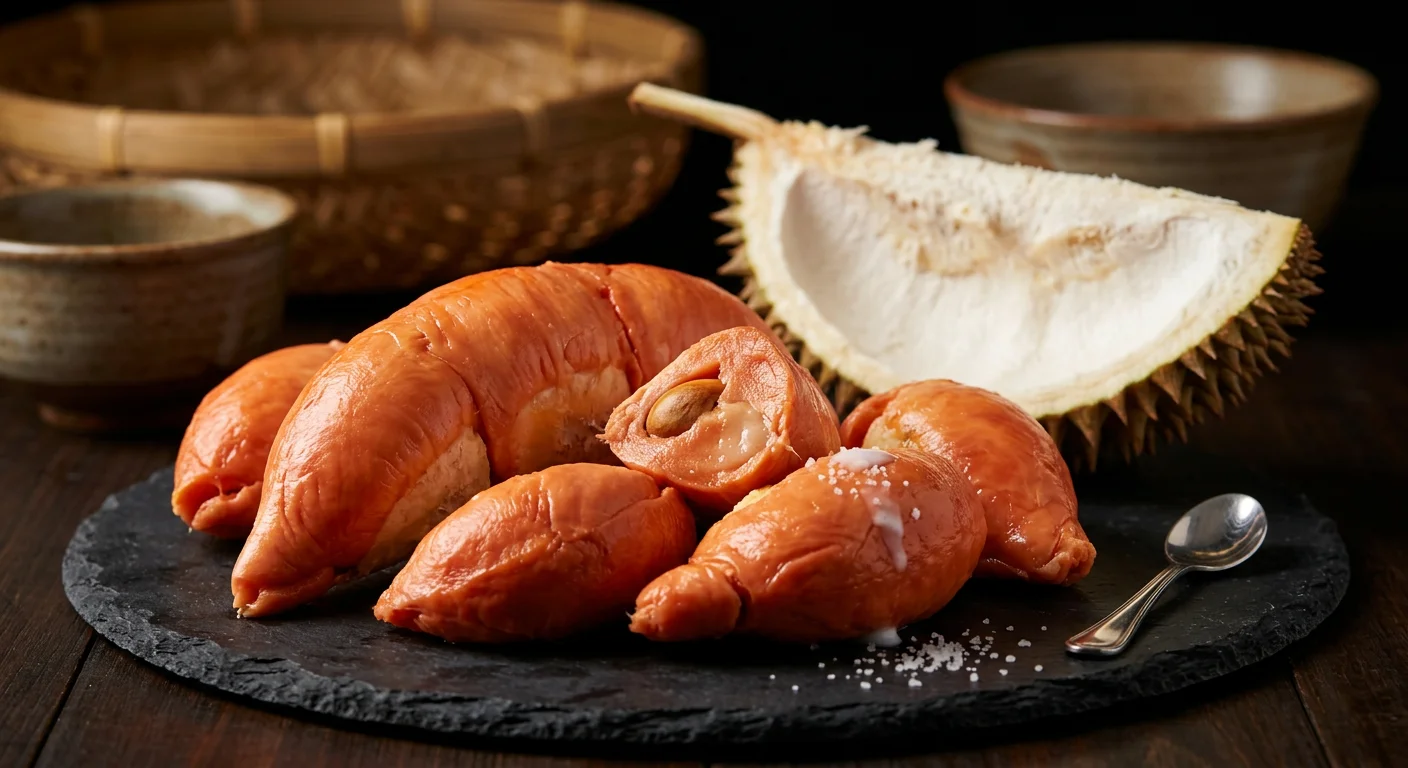
Red Prawn is D175, known in Hokkien as Ang Heh and in Mandarin as Hong Xia. It comes from Penang: DurianPro records it as registered with Malaysia’s Department of Agriculture on 4 June 1990, with Pulau Pinang as the state of origin. It says the name refers to the reddish orange flesh, which resembles cooked prawn, and to the curved shape of each fruitlet. It is not a prawn flavour. We have not read the Department’s own registry entry, because its site did not load for us.
Specialty Produce says it is one of the most popular durians in Penang and is sold at premium prices. DurianPro puts peak-season Grade A Penang fruit at RM 40 to 60 or more per kilogram, which it says competes with Musang King. We have not found a source for how it is priced in Singapore.
How to spot it
DurianPro describes an elongated elliptical shape “sometimes compared to a rugby ball”, a “dull grey-brown husk”, and thorns that are “short, thin, and widely spaced”. FairPrice describes a “dusky brown husk with petite spikes”.
One feature separates it from its usual impersonator. DurianPro says the thorns “extend all the way down to the bottom of the fruit”, with no bald spot. It also calls the shell “very thick and hard”.
Inside, the sources describe the colour differently. DurianPro says “salmon-pink or reddish-orange”. FairPrice says flesh “can range from bright to pale orange”, and Specialty Produce lists light orange, pale pink, cream and salmon. Specialty Produce says the seeds are small to medium.
What it tastes like
Sweet first. FairPrice describes it as “sweet with a tinge of bitterness”, and Specialty Produce as sweet and “subtly bitter”.
The texture is its other signature: noticeably sticky. FairPrice calls it creamy, sweet and sticky, and Specialty Produce describes the flesh as melting and paste-like. Specialty Produce notes red wine, berry and chocolate-like nuances.
Specialty Produce describes the scent as soft, floral and sweet, and milder than other varieties.
Against D13, which is the variety most often sold in its place, FairPrice lists D13 as having large seeds, and calls its taste “fragrant, sweet and sticky”. We have not found a source that compares Red Prawn and Musang King directly.
What to watch for
This is the variety most worth checking before you pay, because much of what is sold as Red Prawn in Singapore is D13. Specialty Produce says “in Singapore, D13 durians are often sold under the name Singapore Red Prawn”, and that these “are not the same variety”. Durianed links D13 to farms in Johor, most associated with Batu 13 in Pagoh, and says “in 2022, it was registered with the number D226”. It is a different durian from D175 and does not come from Penang.
Some sellers are upfront about it and label theirs “Singapore Red Prawn”, as FairPrice does. A Penang fruit is then labelled “Penang Red Prawn”. DurianPro calls this an informal convention, not an official standard.
Three checks, in order of reliability:
- Seeds. D175 runs small to medium (Specialty Produce). D13 has large seeds (FairPrice, Durianed).
- Base. D175 carries thorns down to the bottom (DurianPro). Durianed says D13 has “a bald spot” at the base without the star pattern of Musang King.
- Husk. DurianPro gives D175 a dull grey-brown husk. Durianed calls the D13 husk “a fresh green”.
Flesh colour is a weaker guide. FairPrice calls D13 “bright orange”, while Durianed calls it “dark orange” that is almost red, and says an opened D13 can look more like Red Prawn than Red Prawn does. No single check is a guarantee, so it is worth checking more than one. The stall-side sequence covers the general version.
Who it suits
Anyone who wants a durian that is sweet first, with only a tinge of bitterness, and who is happy with a very soft, sticky texture. Specialty Produce calls the fruit fragile with a short shelf life, and says grafted fruit stay in their growing regions because they cannot be shipped.
Be clear about which one you are buying. Info Pertanian says D13’s seeds are much larger than other Malaysian durians, offset by a lower price, so the gap between D175 and the fruit commonly sold as it is a gap in price as well as provenance.