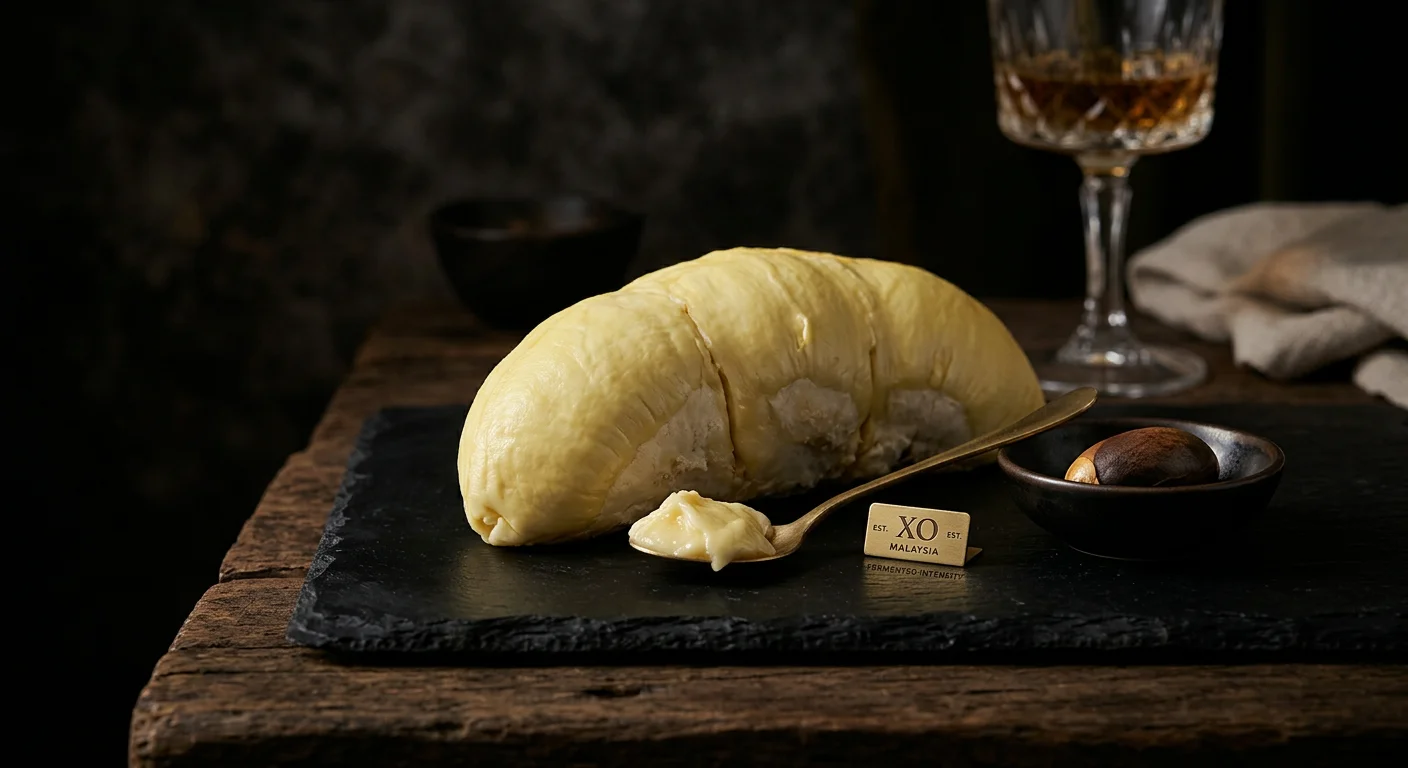
What it actually is
XO is not a registered clone. That is the single most useful thing to know before you buy one. It does not appear on Malaysia’s clone register and has no D number. One orchard worker quoted by Kosmo calls it a variation of D24, and SAYS says its alcoholic taste comes from fermentation inside the shell. Where and how long the fruit ferments is not documented in any standard, and some sources treat XO as a distinct type, so it is best understood as a ripeness style rather than a breed.
The base fruit, D24, is one of the oldest clones on Malaysia’s register, recorded by the Department of Agriculture as registered on 30 November 1937 from Bukit Merah, Perak. A copy of the clone register calls it the most popular clone.
XO is sometimes mislabelled with a D number such as D2. D2 is a separate registered clone called Dato Nina, from Melaka, registered in 1934 according to the same copy of the clone register, and it has nothing to do with XO. The full clone register is on our durian types page if you want to check a claim.
How to spot it
If the fruit is D24, you identify it with D24’s markers. There is no separate XO look.
The Department of Agriculture puts a D24 at 1.0 to 1.8kg, with a thin, light green husk. The thorns are sharp, with one noticeably smaller thorn in every five. The department also lists a spine-free patch at the base about the size of a 5 sen coin, and a distinct corky ring. Our guide on how to choose durian covers base and stem checks in more detail.
Inside, the department describes D24 flesh as pale yellow. SAYS gives XO’s texture as creamy with a hint of firmness. Do not rely on texture alone to tell XO from ordinary D24.
What it tastes like
SAYS gives XO’s flavour as sweet and slightly alcoholic, and says the name comes from XO liquor, because of the slightly bitter, alcoholic taste that fermentation inside the shell gives it.
Against ordinary D24, which the Department of Agriculture describes as sweet, rich and slightly bitter, the difference is the alcoholic note that fermentation adds.
It suits people who already like that fermented, alcoholic note. If you have only ever eaten sweet kampung durian or milder clones, XO is a hard second step.
What to watch for
The naming confusion is the trap here. XO is sold under its own name, sometimes under a wrong D number, and sometimes simply as “premium D24”, which tells you nothing about how far it has fermented. Ask the seller directly: is this D24, and how long was it held?
The other issue is consistency. Because fermentation depends on timing, fruit can vary from one to the next. Eat it soon after opening, as with any durian.
On price, remember the usual arithmetic: the department gives D24 flesh as 26 per cent of the fruit, so whole-fruit and packed-flesh prices are not comparable. Compare the price per kilo with ordinary D24 before paying a premium; see the 2026 season update for how prices moved this year.
Who it suits
XO suits experienced durian eaters who already like D24 and want the alcoholic edge that fermentation adds. It is not a beginner fruit, and it is a poor choice for converting someone who is durian-curious but uncommitted. Some eaters prefer it after plain food rather than rich dishes.